The modern AI ecosystem is built out of classic, reliable software engineering patterns wrapped in venture-capital marketing noise. Loop engineering is a while loop, ReAct agents are API calls in an if block, state graphs are finite state machines, guardrails are input/schema validation, and harnesses are middleware. If you understand basic software fundamentals, you already know 95% of AI engineering.
If you spend five minutes on tech Twitter or LinkedIn right now, you will hear that we are no longer "programmers." We are "Loop Engineers." We are architecting "Agentic Graph Workflows" protected by "Cognitive Guardrail Harnesses."
It sounds profound. It sounds like you need a PhD in computational neuroscience just to write a script.
Here is the quiet truth: it is almost entirely marketing noise.
Strip away the venture-capital vocabulary, and underneath the hood, the entire modern AI ecosystem is built out of boring, reliable software engineering patterns you probably learned in your first year of coding.
Let’s translate the biggest buzzwords back into plain English.
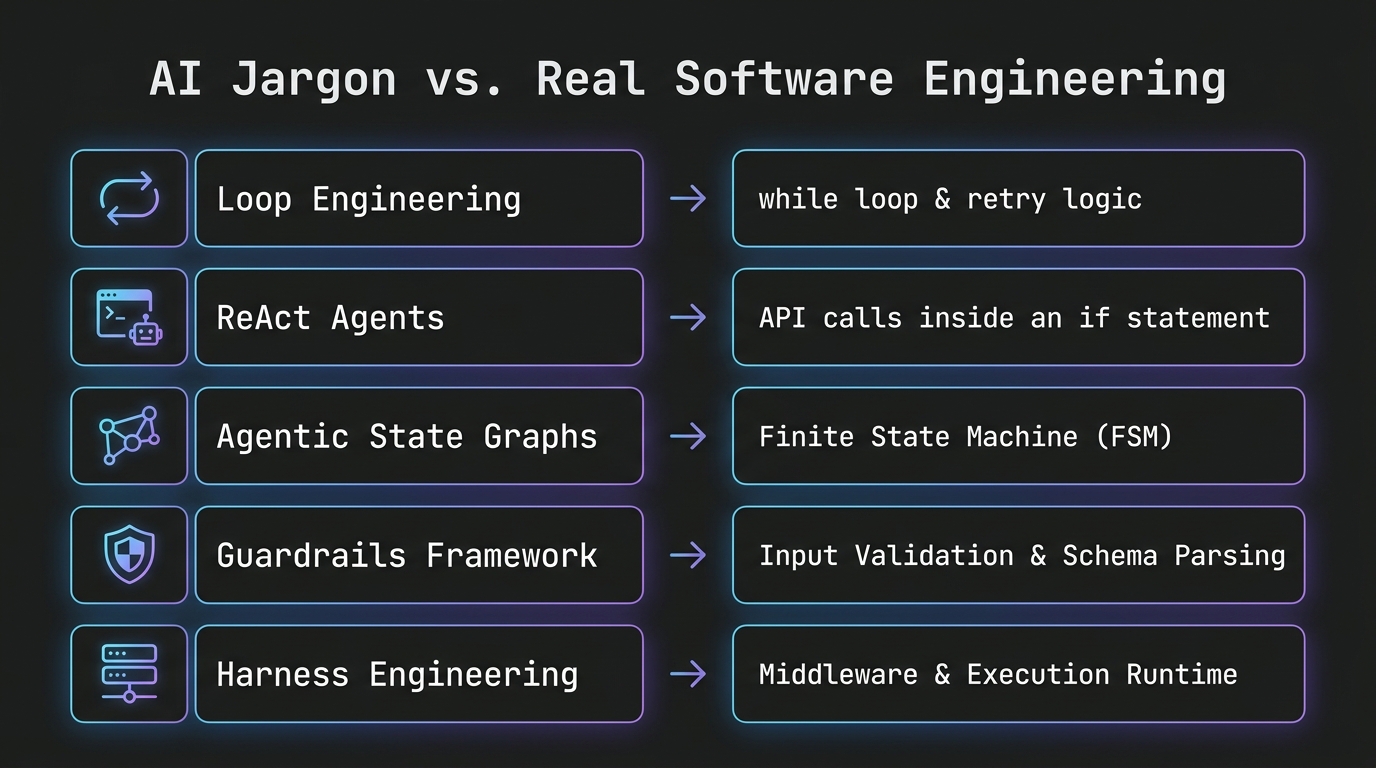
1. "Loop Engineering" is just a while loop
The premise of "Loop Engineering" is sold as a breakthrough: instead of typing one prompt and praying, you make the AI refine its work automatically.
In code, this is literally just:
while (!isDone && attempts < maxAttempts) {
  output = callAI(task, previousFeedback);
  if (passesTests(output)) {
    isDone = true;
  }
}
That’s it. You ask the model for output, run a check, and if it fails, you feed the error message back to the model until it fixes the bug or hits your timeout. Calling this a "novel engineering paradigm" is like calling an if/else statement a "bifurcated logical decision framework."
2. "ReAct Agents" are just API calls inside an if block
"ReAct" stands for Reason + Act. It sounds like self-aware autonomy, but it is just a simple sequence:
- The AI outputs:
{"tool": "fetchWeather", "params": {"city": "Delhi"}} - Your server runs
fetchWeather("Delhi"). - Your server passes the JSON response back to the AI.
- The AI uses that data to finish its sentence.
It’s not artificial consciousness deciding to explore the world. It’s an application switching between an LLM API and a database query.
3. "Agentic State Graphs" are just State Machines
When someone talks about building a "multi-agent graph topology," they mean a Finite State Machine (FSM).
If you have a workflow where a scraper runs first, then a writer drafts an email, and finally an editor approves it, you have a sequence of functions with conditional transitions:
- If the scraper returns an error → jump to the search function.
- If the scraper succeeds → jump to the summarizer.
We used state machines to build checkout carts and video game enemy logic in 1995. Wrapping it around an LLM API does not make it a new branch of computer science.
4. "Guardrails" are just Input Validation and Error Handling
Companies raise millions of dollars selling "Guardrail Frameworks." What do they actually do?
- Input Guardrails: Checking if a user’s prompt contains SQL injections, API keys, or banned words. In normal software, we call this input sanitization or regex.
- Output Guardrails: Checking if the AI returned valid JSON that matches your schema before your app crashes. In standard web development, we call this schema parsing (like using Zod or Joi).
You don't need a specialized "Cognitive Safety Layer" to check whether a string has a valid email address inside it. A plain schema check does the job for zero dollars.
5. "Harness Engineering" is just Middleware
An LLM by itself is just a function that accepts text and predicts the next few words. It cannot open a terminal, read a file, or query Postgres on its own.
A "harness" is simply the environment wrapper around that function. It holds the environment variables, manages API rate limits, runs shell commands, and captures stderr. In classic backend development, we called this an execution runtime or middleware.
Why Did Everyone Invent These Words?
Two reasons: novelty sells, and unpredictable systems need defensive code.
Because language models produce non-deterministic text instead of reliable types, developers have to wrap them in layers of defensive assertions, retries, and checks. Because "I wrote three assertions and a retry loop around an API call" doesn't sound worth a $100k enterprise contract, the industry renamed it "Autonomous Self-Healing Agent Architecture."
The takeaway for builders is liberating: you don't need to learn a massive suite of bloated AI frameworks to build powerful tools. If you know how to write clean functions, run basic unit tests, validate schemas, and handle errors, you already know 95% of what it takes to build an agent.
Don't let the jargon convince you that the fundamentals of good programming have changed. They haven't.