Attended the Agents & APIs SF Developer Meetup brought to you by Postman at CANOPY Jackson Square in San Francisco. The three standout revelations: (1) Canva's Model Context Protocol (MCP) server connects directly to Claude (rolling out in ~2 weeks) to automate visual design and image generation programmatically, (2) smol machines (YC P26) is building branchable cloud micro-VMs that allow instant state checkpoints and rollbacks for agent sandboxes, and (3) Scope (YC P26) is pioneering telemetry for AI agents discovering and consuming APIs as first-class users.
I spent an evening at the Agents & APIs SF Developer Meetup, hosted by Postman (featuring talks from Canva, smol machines, and Scope) at CANOPY Jackson Square in San Francisco. If you haven't been to an engineering meetup in SF recently, the energy has undergone a distinct shift: people are no longer talking about superficial prompt engineering wrappers. The conversations are grounded in real developer plumbing—protocols, execution runtimes, branchable state machines, and how autonomous agents interact with existing APIs.
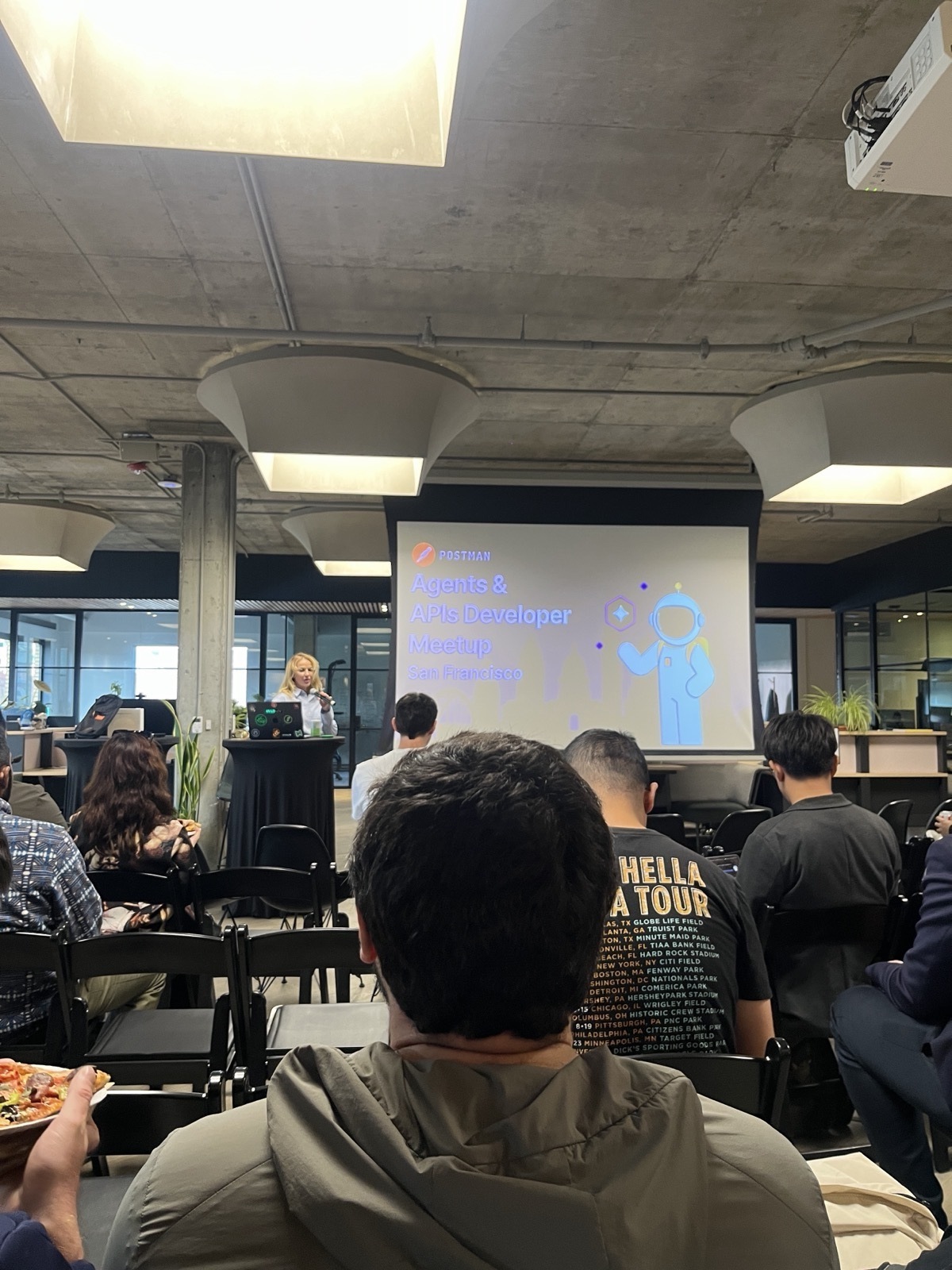
Three talks in particular painted a vivid picture of where the developer toolchain is heading over the next 12 months. Here are the unfiltered notes and engineering takeaways.
1. Canva's MCP Server on Claude: Why Can't Your Agent Design Anything?
Speaker: Meredith Hassett, Sr. Developer Advocate at Canva
Talk: "Your Agent Can Talk to Slack, Stripe, and Postgres. Why Can't It Design
Anything?"
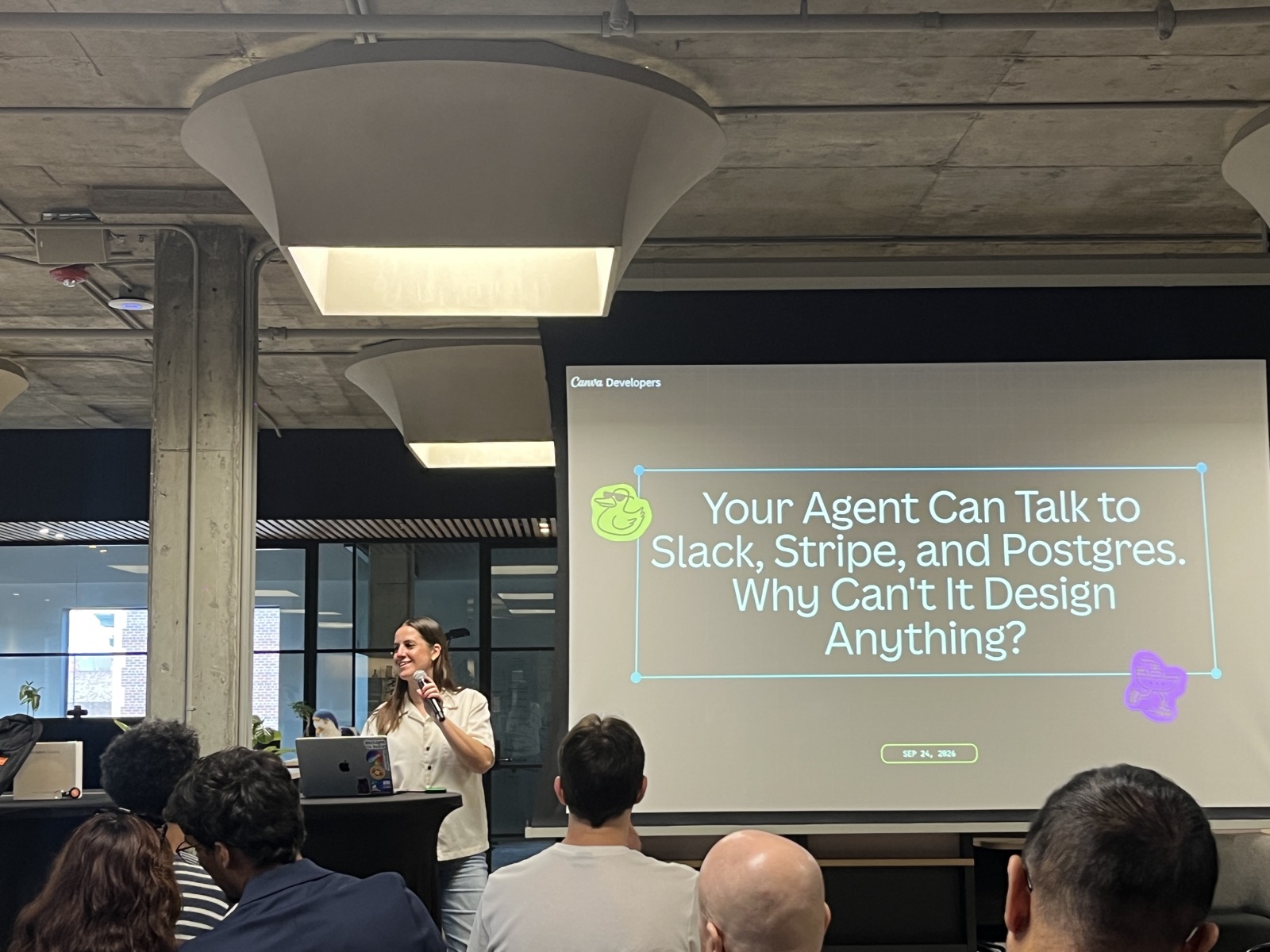
Meredith posed a sharp question to the room: today's AI agents can query Postgres databases, send transactional Slack notifications, and trigger Stripe payment intents. But the moment you need visual collateral—social media banners, automated pitch decks, infographic cards, or localized ad creative—the automation chain breaks down and requires human design handoff.
The Big Announcement: Canva MCP Server on Claude
Canva demonstrated their brand new Model Context Protocol (MCP) server that connects Canva directly into Claude (Anthropic), scheduled to roll out publicly within the next two weeks.
Instead of manually downloading images or piecing together messy pixel coordinates, Claude can now leverage Canva's structured design APIs via standard MCP tool calls:
- Asset & Brand Kit Discovery: The agent inspects brand guidelines, colors, approved typography, and logos stored in a team's Canva workspace.
- Template Instantiation & Element Binding: Claude selects appropriate Canva templates and programmatically maps variables (headlines, body copy, product photos, pricing tables).
- Batch Creative Generation: You can prompt Claude: "Generate 10 localized Instagram promo assets for our fall release using our verified palette", and the Canva MCP handles the layout rendering, layer alignment, and export.
Connecting MCP to a creative powerhouse like Canva marks a massive milestone for autonomous workflows: agents are graduating from plain markdown text outputs to full-fidelity visual production.
2. smol machines: A Branchable Computer for Agent Sandboxes
Speaker: BinBin He, Founder of smol machines (YC P26)
Talk: "A branchable computer: Start once, branch and roll back your cloud
workloads"
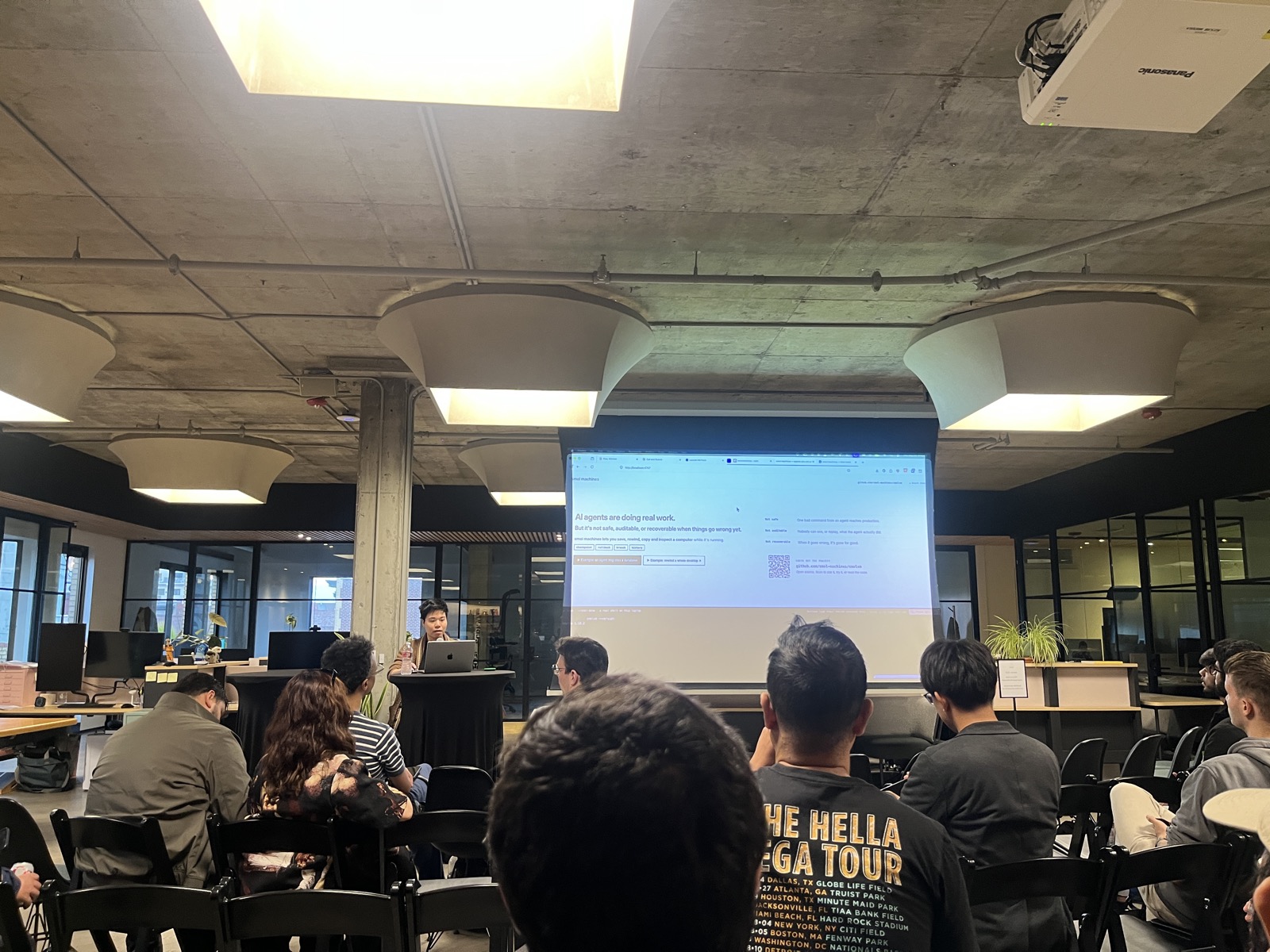
As anyone who has built coding agents (like Claude Code, SWE-bench runners, or autonomous bash tools) knows, unconstrained agent execution is chaotic. An agent will modify packages, alter local databases, mutate environment variables, or occasionally run a destructive script that destroys the container state.
Traditional cloud instances and Docker containers make recovery slow: if an agent fails 8 steps into a 10-step task, restarting from scratch means losing 5 minutes of setup and compute tokens.
How smol machines Solves State Persistence
BinBin showed off smol machines—a branchable virtual computing substrate designed specifically for AI agent sandboxes:
- Instant Checkpointing: Save the exact RAM, CPU, and disk snapshot of a running VM at sub-second speeds.
- Git-Like Branching: Branch a running computer into parallel environments
(
branch-Aandbranch-B) so the agent can test two different refactoring strategies simultaneously. - Zero-Cost Rollback: If an agent executes a faulty migration or encounters an unrecoverable runtime error, you instantly rewind to step 4 without rebuilding the container.
This is what the next era of cloud infrastructure looks like: computing environments that are as fluid, version-controlled, and recoverable as Git commits.
3. Scope: Agents Are the New End-Users of Your API
Speaker: Anand-Arnaud Pajaniradjane, Founder of Scope (YC P26)
Talk: "How are AI agents like Claude Code or Codex discovering and using your
product?"
Anand-Arnaud presented a fascinating shift in how web traffic and product analytics are evolving. For twenty years, web analytics (Mixpanel, Google Analytics, PostHog) have been architected around human behavior: mouse hovers, scroll depth, session replays, and UI funnel conversions.
In 2026, a rapidly growing percentage of product discovery and consumption is performed directly by autonomous AI agents: Claude Code reading your documentation, Cursor indexing your repository, or coding agents calling your OpenAPI spec.
The Blind Spot in Traditional API Monitoring
Traditional API gateways only record status codes (200 OK, 500 Error). They
cannot tell you:
- Which LLM agent is attempting to integrate your service.
- Where the agent got confused by your documentation schema or hallucinated parameters.
- How agent tool-calling patterns differ from human developer requests.
Scope provides visibility and control over how autonomous agents discover and invoke your product, bridging the gap between human developer marketing and machine-readable agent discoverability.
4. The Big Picture: The Emerging Agent Infrastructure Stack
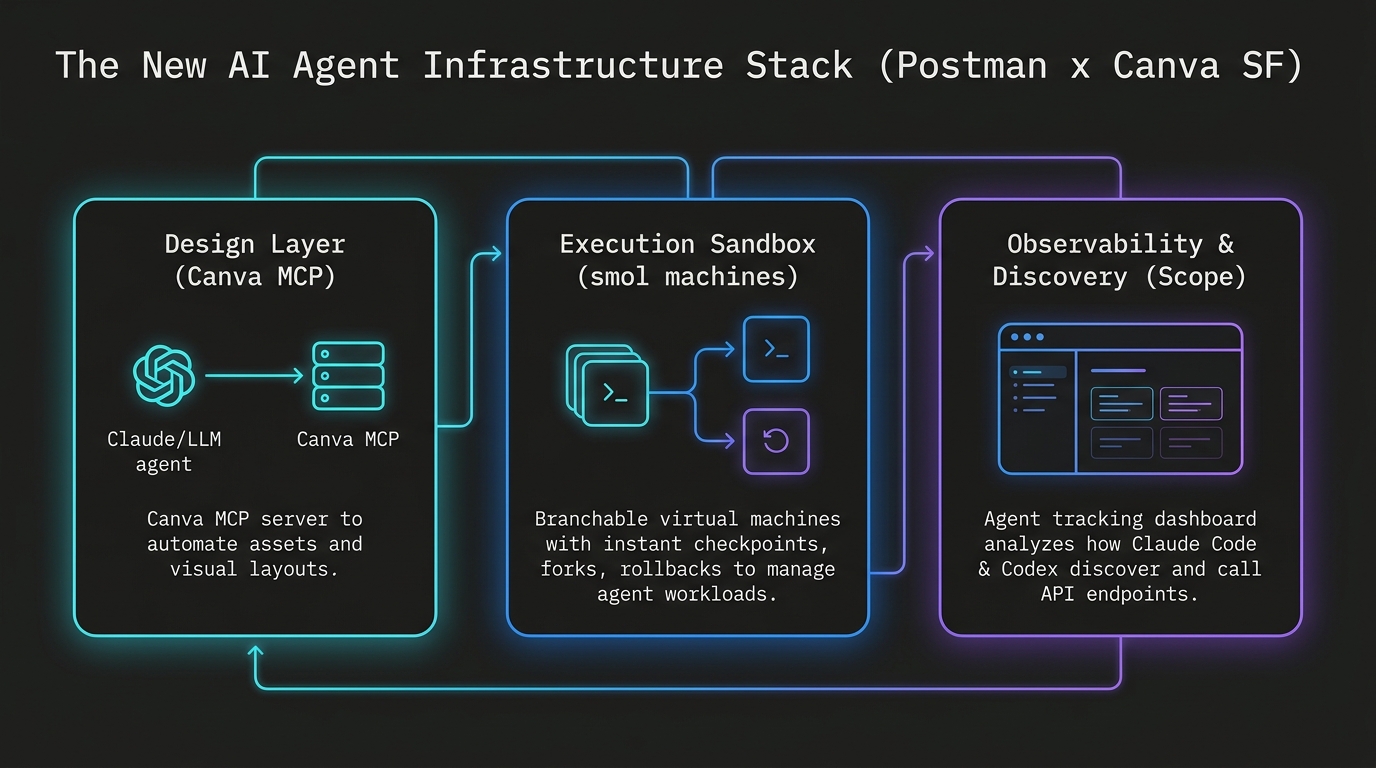
Sitting in the audience and chatting with engineers afterwards, the unifying thread was obvious: the agent stack is maturing from toy scripts into robust distributed systems.
- Tooling Protocols (MCP): Standardized interfaces like Anthropic's Model Context Protocol allow domain-specific giants (like Canva) to expose complex creative engines to any LLM without proprietary bespoke SDKs.
- Stateful Execution Substrates: Fast checkpointing and micro-VM branching (like smol machines) make speculative agent coding reliable and safe.
- Agent Telemetry & Discovery: Observability platforms (like Scope) treat AI agents as first-class product consumers.
Excited to see Canva's MCP rollout land in the wild over the next couple of weeks—and looking forward to testing what happens when we let agents handle our end-to-end design pipelines.