In 1856, synthetic dye took purple from an imperial luxury requiring 10,000 sea snails down to a factory chemical costing pennies. The color didn't change—the scarcity did. Today, AI is doing the exact same thing to code and software. When the marginal cost of execution collapses to zero, building a prototype ceases to be a moat. The "next purple" shifts to taste, discernment, lived context, and solving messy real-world friction.
For centuries in ancient Rome, wearing purple could get you executed.
It wasn't because of a religious taboo or superstition. It was about raw economics. The dye—known as Tyrian purple—was harvested from the mucous glands of tens of thousands of spiny dye-murex sea snails. Workers had to crack open rotting mollusks by hand, boil them in lead vats for days, and endure a stench so vile that dye workshops were legally banished outside city limits.
It took roughly 10,000 snails to extract a single gram of dye—just enough to color the hem of a garment.
Because of that, purple cost more than its weight in gold. Only emperors and monarchs could afford to wear it. The color itself wasn’t inherently superior to green, red, or brown; it was an undisputed signal of immense labor, scarcity, and power. If you saw someone wearing purple, you knew they sat at the pinnacle of society.
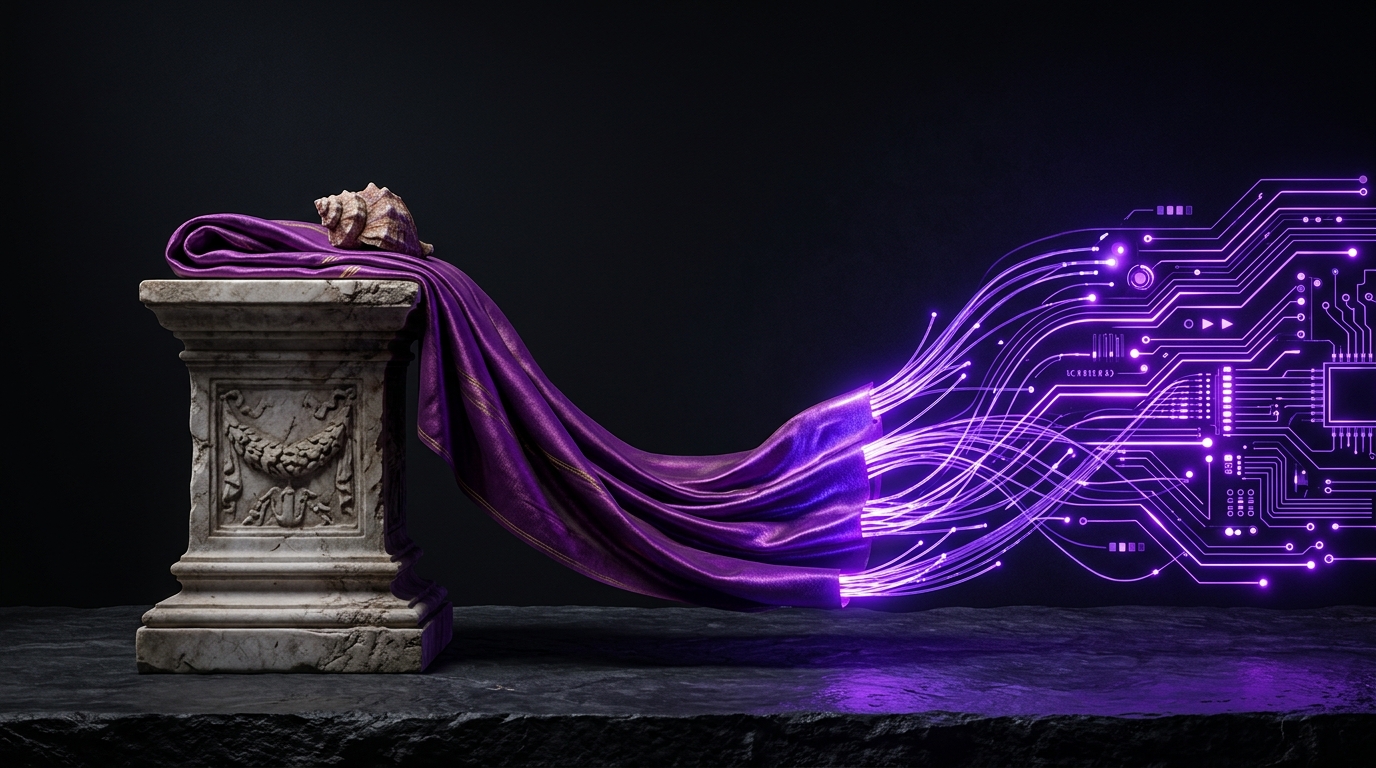
Then, in 1856, an 18-year-old chemistry student named William Henry Perkin tried to synthesize artificial quinine to treat malaria. He failed. Instead, his beaker filled with a dark, oily residue that left a vivid violet stain on silk. He had accidentally invented the world’s first synthetic dye: mauveine.
Almost overnight, what once required months of labor and thousands of sea snails could be cooked up in a factory for pennies.
Within a few years, purple dresses were sold in department stores. Servants wore purple. Schoolchildren wore purple. The mystique vanished. If you walk into a store today and buy a $10 purple t-shirt, nobody thinks you are an emperor. Nobody even looks twice.
The color didn’t change. The scarcity did.
Software Just Had Its Synthetic Dye Moment
For the past thirty years, building software was our version of harvesting sea snails.
If you wanted to build an app, you needed a team of specialized engineers. You needed someone who understood databases, someone who could wrestle with CSS, someone who could wire up payments, and someone to keep the servers alive. Writing code was hard, expensive, and slow. If a company launched a polished product, that launch alone was a demonstration of capital and technical labor.
Code was the purple cloak.
In the last five or six years—and especially in the last twenty-four months—AI handed everyone Perkin’s beaker.
Today, you can describe an entire web app in plain English, and a model will spit out functional code in thirty seconds. You can generate illustrations, draft marketing copy, spin up databases, and automate workflows before your morning coffee gets cold. Tasks that once justified a $20,000 contract or three months of sprint cycles now cost fractions of a cent in API tokens.
The cost of execution has collapsed toward zero.
And that leaves us with a question that every builder, engineer, and creator needs to confront:
If anyone can build anything in an afternoon, what is the next purple?
The Flood of Cheap Mauve
When synthetic purple first flooded London and Paris, people initially lost their minds. They dyed everything purple. Every skirt, ribbon, curtain, and hat became violet. The Victorian press even called it "mauve measles."
It didn't take long for the novelty to wear off. Once everyone was wearing purple, it stopped meaning anything.
We are currently living through the "mauve measles" era of generative technology.
Open your feeds. Every day there are ten thousand new AI wrappers, five hundred auto-generated newsletters, endless synthetic LinkedIn essays, and cloned SaaS tools. Everyone has access to the exact same models, the exact same prompt templates, and the exact same average outputs.
Because the barrier to producing something has dropped to zero, the world is suddenly drowning in median-quality noise.
When execution is no longer scarce, execution stops being impressive. Building a working prototype used to prove you were capable. Today, it just proves you have an internet connection.
So What Actually Matters Now?
If the ability to produce software, content, and code is now as cheap as synthetic dye, value has to move somewhere else. It retreats to the things that cannot be distilled into next-token prediction.
Here is what the next "purple" looks like:
1. Taste and Discernment
When an engine can generate forty variations of a landing page in ten seconds, the hard part is no longer generating the options. The hard part is knowing which thirty-nine to throw in the trash.
Taste is the quiet ability to recognize what feels human, what feels balanced, and what actually solves a problem versus what just looks clever. AI has no taste; it only has statistics. It averages out the entire internet and gives you the median. Taste is the human filter that says, "No, this feels sterile. Cut this paragraph. Remove this feature. Let’s make this interaction effortless."
In an age of endless generation, editing is a superpower.
2. Lived Context and Scars
An LLM has read every post-mortem ever published on the web. But it has never sat on a 3:00 AM incident call watching a database lock up while angry customers flood support channels. It has never negotiated a difficult contract, felt the gut punch of a churned client, or understood the political tension between a product team and a sales team.
The prompts that produce great tools don't come from clever phrasing; they come from deep, messy, domain-specific pain. Knowing what problem is actually worth solving requires living inside the problem. The moat isn't the code; the moat is the insight.
3. Real Friction and Trust
Generating digital pixels is free. Dealing with messy physical reality is not.
Connecting an API to a real bank, navigating compliance, earning the trust of a skeptical customer, showing up in person, building a brand that people rely on when things break—these things cannot be synthesized in a prompt. AI can write the code for an application in minutes, but it cannot manufacture trust.
Trust is built slowly, across repeated interactions where a human stands behind the work.
The Liberation of the Builder
It’s easy to look at the rapid rise of AI and feel an existential dread—to think, "If a machine can write code faster than me, what am I here for?"
But look back at what happened after synthetic purple was invented.
Textile makers didn't stop existing. Fashion didn't die. In fact, the democratization of dye freed designers from being obsessed with the mere cost of a pigment. They could finally focus on cut, silhouette, movement, texture, and style. The color was no longer the gimmick; the design had to stand on its own merit.
That is where we are heading.
The fact that code is becoming free isn't the end of building; it's the end of using syntax as an excuse. You no longer get points simply for knowing how to configure a build pipeline or write boilerplate CRUD logic.
The playing field has been cleared. The cheap tricks are gone.
The next purple isn’t a technical trick you can copy from a tutorial. It’s your judgment, your taste, your willingness to solve problems nobody else wants to touch, and the care you put into what you make.
Anyone can buy the dye now. The only question left is what you’re going to paint with it.